
Lawn Care and Snow Removal
Salting and De-Icing in Nelsonville
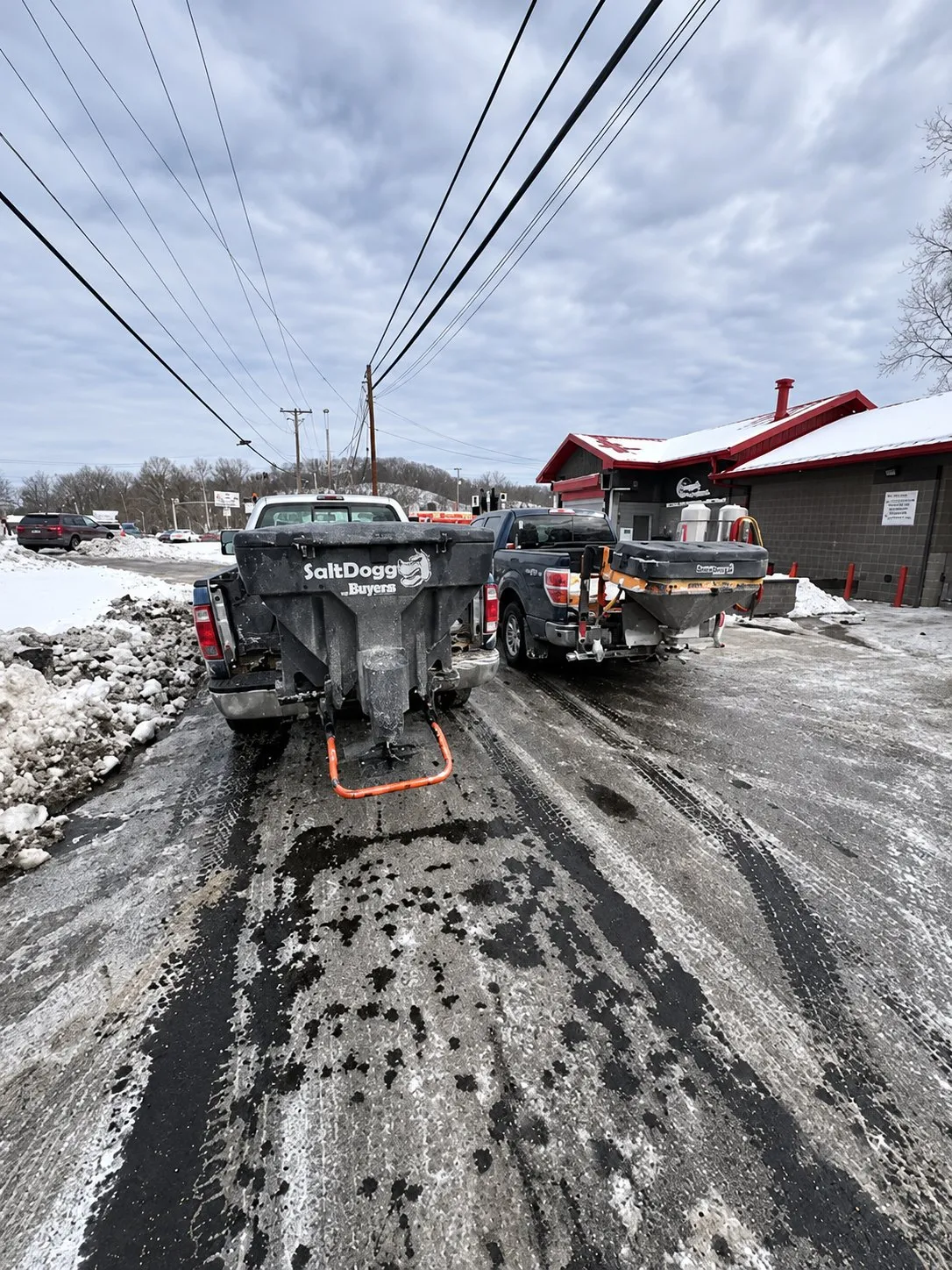
Salt and de-icing for lots, drives, walks and entrances, including the refreeze that shows up after the plow has gone.
Why Both
Why Does a Lot Need Salt After It Is Plowed?
Because a blade cannot get everything. Plowing takes the depth off, but what is left is a thin bonded layer of packed snow and ice that the blade rides over, and that layer is what people slip on. Then traffic polishes it, the afternoon sun melts the top of it, and overnight the meltwater refreezes into something considerably more dangerous than the snow was.
Salt is what breaks that cycle. It lowers the freezing point so the bonded layer releases from the pavement and the refreeze does not set up overnight. Plowing and salting are two separate passes doing two different jobs, and a property that gets one without the other is only half handled.
Coverage
What Gets Salted on a Property?
The surfaces people walk on first, then the surfaces they drive on. Most slips happen between the car and the door rather than out in the middle of a lot.
- Entrances and the approach to every door people actually use
- Sidewalks and the walkway from the parking to the building
- Steps, ramps and accessible routes, which ice over first and matter most
- Drive aisles and the lanes that carry turning traffic
- Any slope where meltwater runs across pavement and refreezes
- Shaded corners that never see sun and stay frozen after everything else has cleared
Limits
When Does Salt Stop Working?
Rock salt loses its effectiveness as the pavement gets colder, and well below freezing it mostly sits there. That is worth knowing because it is the point at which people assume the salt was no good or nobody showed up.
In a deep cold snap the answer is a different material or a different approach rather than more of the same salt, and we will tell you which one your property needs on a given night rather than spreading something that is not going to do anything. Timing matters as much as material: salt put down before a storm keeps ice from bonding to the pavement in the first place, which takes less material and works better than trying to break a bond that has already set.
Salt Alone
Can You Salt Without Plowing?
Yes, and some properties get salted on nights we never plow at all. A freezing drizzle, a hard refreeze after a warm afternoon, or black ice forming on a clear night are all situations with no snow to move and a real hazard on the pavement.
Those are the nights that catch properties out, because nothing about the weather looks like a snow event. For commercial accounts we watch for them rather than waiting for a call. If you are already on Commercial Snow Plowing with us, salting runs as part of the same winter arrangement, and for homeowners it is usually about the walk and the steps rather than the driveway, alongside Residential Snow Plowing.
Surfaces
Is Salt Safe for Concrete and Landscaping?
Used sensibly, on sound pavement, it is fine. Used heavily it is hard on young concrete, on pavement that is already spalling, and on the turf and plantings along the edge where the meltwater runs off and the salt concentrates in the soil.
So the goal is enough to make the surface safe and no more, applied where it is needed rather than broadcast everywhere. Concrete poured within the last year wants particular care, and if you have new pavement, tell us where. The beds along a salted walk take the runoff, so on properties where we also handle the grounds we keep that in mind when deciding what goes next to those walks in the spring.
Common Questions
Salting and De-Icing FAQ
Can you salt before a storm instead of after?
Yes, and it is often the better call. Treating the pavement ahead of a storm keeps ice from bonding to it, which takes less material and leaves a surface that is easier to clear once the snow arrives.
How long does a salt application last?
It depends on temperature, traffic and whether the sun gets to the surface. A lot that is busy all day works the salt into the pavement faster than a quiet one. On a long storm or a hard refreeze overnight, a second application is normal rather than a sign the first one failed.
Do you salt residential driveways?
We do, though for most homes the walks, the steps and the approach to the door matter more than the driveway itself, since that is where people are on foot.
Is there an option that is easier on concrete and plants?
There are alternative de-icing materials that are gentler on surfaces and landscaping, and they cost more per application. On a property with new concrete or sensitive plantings along the walks, it is worth discussing at the quote rather than after the damage.
More Services
Other Work We Handle
Reviews
What Our Customers Say
Our customers leave their own words on our Google profile.
 Find Us on Google
Get In Touch
Contact Us
Tell us about the property and what you need for salting and de-icing. We will come look before we quote.
Contact Us
Tell us about the property and we will get back to you.